Category: Practice Transitions & Valuation

Buying or selling a dental practice: valuation, due diligence, asset allocation, deal terms, DSO transitions and the real estate side of a sale.

  • The Hidden Growth Trap: Why Buying a Small Practice Can Limit Your Future Success (And How to Avoid It)

    The Hidden Growth Trap: Why Buying a Small Practice Can Limit Your Future Success (And How to Avoid It)

    Many dentists dream of practice ownership. When the moment arrives, a common “safe” choice is to purchase an existing smaller practice rather than launching a de-novo startup. The appeal is obvious: immediate patient flow, proven revenue, and what feels like lower risk and faster entry into ownership.

    At Masserano Practices, Align Health Care Real Estate, and Align Health Care Practices, we’ve guided hundreds of doctors through both acquisitions and startups. Time and again, we see the same painful pattern emerge — what we call the “Hidden Growth Trap.”

    It starts with a fundamental difference in how lenders evaluate financing — and it can quietly cap your income, restrict your lifestyle, and reduce the long-term value of your largest asset. For a closer look at the trade-offs of purchasing a ready-to-use office, see To Buy or to Build: Benefits & Disadvantages of Purchasing a Turn-Key Dental Practice.

    Acquisition Financing vs. Startup / Project Financing

    Banks and dental-specific lenders underwrite the two paths very differently:

    Practice Acquisition Loans are based primarily on historical performance. If the practice has consistent earnings, lenders are often willing to finance the majority of the purchase price (frequently 80–100% with strong credit and structure). The loan is backed by cash flow that already exists, and it can even include real estate when the seller owns the building.

    Startup or Project Loans (used for scratch builds, major expansions, or relocations) are evaluated on future projections. Lenders rely on industry benchmarks, local demographics, your experience, and realistic ramp-up assumptions. Because there is no proven track record, they will utilize a projection that assumes the long-term growth that would be associated with an optimally designed de novo. This typically results in a no out of pocket loan that is great enough to safely launch a de novo right from the beginning.

    Because some doctors are averse to the risk associated with starting from scratch and the associated financing, many doctors choose the “buy small” route to get into practice more quickly and what would seem to be more affordably at the outset.

    How the Trap Quietly Closes

    The first few years usually feel like a success story. The new owner rebrands, improves operations, builds patient loyalty, and steadily grows production.

    Then reality hits.

    The existing space simply doesn’t have enough operatories, square footage, or layout flexibility to support further expansion. Adding an associate, new technology, or higher patient volume becomes physically impossible.

    The natural next step is to relocate or significantly expand into a larger, purpose-built office. But this requires a new project loan for construction, tenant improvements, and equipment.

    Here’s where the trap snaps shut:

    Project lenders want to see substantial equity in the current practice plus strong recent production numbers to support the larger loan.

    Because the doctor has been constrained by the small space, they haven’t been able to grow production enough to build that equity.

    They can’t increase production to qualify for the loan… because they don’t have the space to grow.

    The result? A doctor who has built a genuinely successful practice — yet feels stuck. Personal income is capped. The ability to hire associates and leverage time is limited. Long-term goals feel further away than ever. And when it’s time to sell, the practice is less attractive to buyers because it lacks scalability.

    Why This Matters for Your Future

    A practice without room to grow eventually becomes less liquid and less valuable. The most desirable and marketable practices — the ones that command premium valuations — are those deliberately designed with expansion potential built in.

    Whether you’re acquiring or starting fresh, the space and location you choose today will determine how easily you can:

    • Increase production and personal income
    • Bring on associates and reclaim your time
    • Qualify for future financing when you’re ready to scale
    • Create a highly desirable, sellable asset when you eventually exit

    The Smarter Path Forward

    The doctors who achieve the greatest long-term success make one key decision early: they choose (or create) a location and physical space that supports their 10- to 15-year + vision — not just their first 2–3 years.

    Before you sign a purchase agreement or a lease, ask the harder questions:

    • Does this space allow for additional operatories or future expansion?
    • Is the location strong enough to support a larger, higher-producing practice?
    • How will this decision affect my ability to build equity and qualify for future project financing?

    Let Us Help You Get It Right the First Time

    At Masserano Practices (www.masseranopractices.com), Align Health Care Real Estate (www.alignhealthcarerealestate.com), and Align Health Care Practices (www.alignhealthcarepractices.com), we specialize in helping doctors evaluate both acquisition and startup opportunities with the long game in mind.

    We analyze real estate potential, expansion feasibility, location strength, financing pathways, and how each option aligns with your personal income goals and lifestyle vision. Our combined expertise in practice design, development, and healthcare real estate lets us run realistic scenarios so you can avoid the growth trap entirely.

    If you’re currently exploring practice purchase opportunities or considering a startup, we invite you to reach out for a no-pressure conversation. Helping doctors build scalable, high-value practices — and avoid costly limitations — is what we do best.

    Let’s make sure your first step into ownership sets you up for decades of success, freedom, and growth.


    Originally published May 26, 2026 on masseranopractices.com.

    Planning a startup, relocation or expansion? See how The Masserano Process works, browse our portfolio, or schedule a free consultation.

  • A New Path to DSO Transitions: When the Associate Becomes the Key to the Sale

    A New Path to DSO Transitions: When the Associate Becomes the Key to the Sale

    Over the past several years, we’ve worked with practice owners at every stage of their careers—from early growth to full transition. Historically, when a Dental Service Organization (DSO) acquired a practice, the structure was fairly predictable: the selling doctor stayed on for several years, continued practicing, and received a portion of the total value over time to ensure stability and a smooth transition.

    We have seen something different emerging. In a recent transition situation, we were able to see a deal in which practice owners who were no longer practicing or were only practicing in a limited capacity were still able to complete successful DSO transition without committing to long post-sale employment. In these cases, the associate dentist played a much more central role in the deal structure.

    Why the Traditional Model is Shifting

    In many modern practices, the dentist most closely associated with the practice is no longer the owner.

    Patients often build their relationships with associate dentists. Staff rely on them day-to-day. Schedules, production, and culture increasingly revolve around these clinicians—especially in practices where owners have stepped back clinically. DSOs are noticing this too.

    In the situations we’ve encountered, buyers were less concerned with whether the selling doctor remained long-term and more focused on who the patients and staff identified as “their dentist.” When that dentist was an associate, the deal dynamics changed.

    A Different Way to Structure the Transaction

    In these scenarios, DSOs explored acquisitions where: 1. The seller could exit sooner—or in some cases, not stay at all 2. The associate dentist became an equity stakeholder in the practice 3. Long-term stability was tied to associate retention rather than seller employment

    To support this structure, DSOs were often willing to finance the associate’s equity purchase, typically on favorable terms. What stood out to us was that the financing itself wasn’t a profit center for the buyer. Instead, the emphasis was on the associate’s willingness to invest or take on debt to secure ownership.

    That commitment mattered.

    It signaled alignment, accountability, and long-term intent—key factors for buyers looking to reduce transition risk.


    What This Means for Practice Owners

    For sellers considering this path, there are trade-offs. In some cases, leaving earlier or transferring equity to an associate may result in a slightly lower multiple than a traditional model where the owner remains clinically involved for several years.

    That said, in the situations we’ve reviewed: – The valuation still exceeded what most private sales would deliver – Sellers gained greater flexibility and a cleaner exit – The overall transaction remained attractive to institutional buyers

    For owners who are no longer practicing—or who want to step away sooner—this approach can offer a compelling alternative.

    What This Means for Associates

    From the associate’s perspective, these structures can open doors that didn’t exist before.


    Rather than waiting years to purchase a practice outright, associates may be offered an ownership position as part of a larger transaction. In some cases, this equity comes with support, structure, and financing that reduces upfront risk while still creating long-term upside.


    We’ve also begun to see how this thinking could extend beyond acquisitions and into startup opportunities, where DSOs back new locations and offer equity paths to associates from the outset.

    Why This Matters Now

    We’re not suggesting this model replaces traditional DSO acquisitions. Many deals will—and should—continue to rely on the selling doctor’s ongoing involvement.

    But based on what we’re seeing firsthand, deal structures are becoming more flexible, and equity alignment is playing a bigger role in how buyers evaluate risk, stability, and long-term success.

    At Align + Masserano, we work at the intersection of valuation, real estate, design, and transitions. Because we’re involved before, during, and after these deals, we’re often able to identify alternative paths that better match a doctor’s goals.

    If you’re curious how buyers may view your practice—or what options could exist beyond a traditional sale—now is the right time to have that conversation.

    Reach out to us to discuss your position, your team structure, and what a smart transition could look like for you.

  • Dual Practice Transition

    Dual Practice Transition

    How this Dual Location Dental Practice Sold for 95% of Gross Revenue- Cash at Closing

    Our Doctor owned two general dentistry practices in a busy suburban area, one well established, the other newer and still growing. With a loyal patient base, strong financials, and an eye toward the future, he wanted to explore a sale. But like many practice owners, he wasn’t just looking for any buyer…he wanted the right deal.

    The Situation: The Doctor’s practices were impressive and uniquely positioned:

    • Practice A: 10 years old, 8 ops, high production, consistent performance.
    • Practice B: 2 years old, 9 ops (partially equipped), still building momentum.
    • Both practices in high traffic areas, one in a medical complex and the other in a grocery anchored retail center.
    • The Task: Ideally, sell both practices together, but open to selling separately for the right deal.

    The Challenge: The mixed maturity of the two practices created complexity.

    • Private buyers were mostly interested in the established practice but didn’t have the bandwidth or financial strength to take on both locations.
    • DSOs were eager to buy both practices, but their offers came with longer employment tie-ins, structured payouts, and less immediate control for the doctor.

    The Offers: Align took the practices to market with both private buyers and group buyers (DSOs), carefully evaluating proposals.

    • Private Buyer Offer:
      • ~85% of gross revenue
      • All cash at closing
      • 3-month transition
      • Buyer only wanted the mature practice
    • DSO Offer:
      • ~125% of gross revenue (~8x EBITDA)
      • 40% cash at closing
      • Equity + note payable over 5 years
      • 5-year employment contract

    The Seller’s Dream?

    The price of the DSO deal…
    The freedom of the private deal.
    But usually, sellers can’t have both.

    The Solution: A Third Path

    Align HCP used our network to identify a rapidly growing mini-DSO buyer. This group was nimble, well-capitalized, and didn’t require long-term employment commitments.

    Final Deal Terms:

    • ~95% of gross revenue
    • All cash at closing
    • 3-month transition
    • Both practices sold together
    • Leases successfully assigned and modified to accommodate buyer

    It was the best of both worlds, a strong valuation with the flexibility the Doctor wanted.

    Thinking About a Sale in the Next 1–3 Years?

    You can request a Seller Readiness Check-In to help you plan ahead. Whether you’re a few years out or just getting curious, we’ll help you understand your options and get set up for success.


    Request a Seller Readiness Check-In

  • Designing for Transition: Boosting Practice Value Through Strategic Upgrades

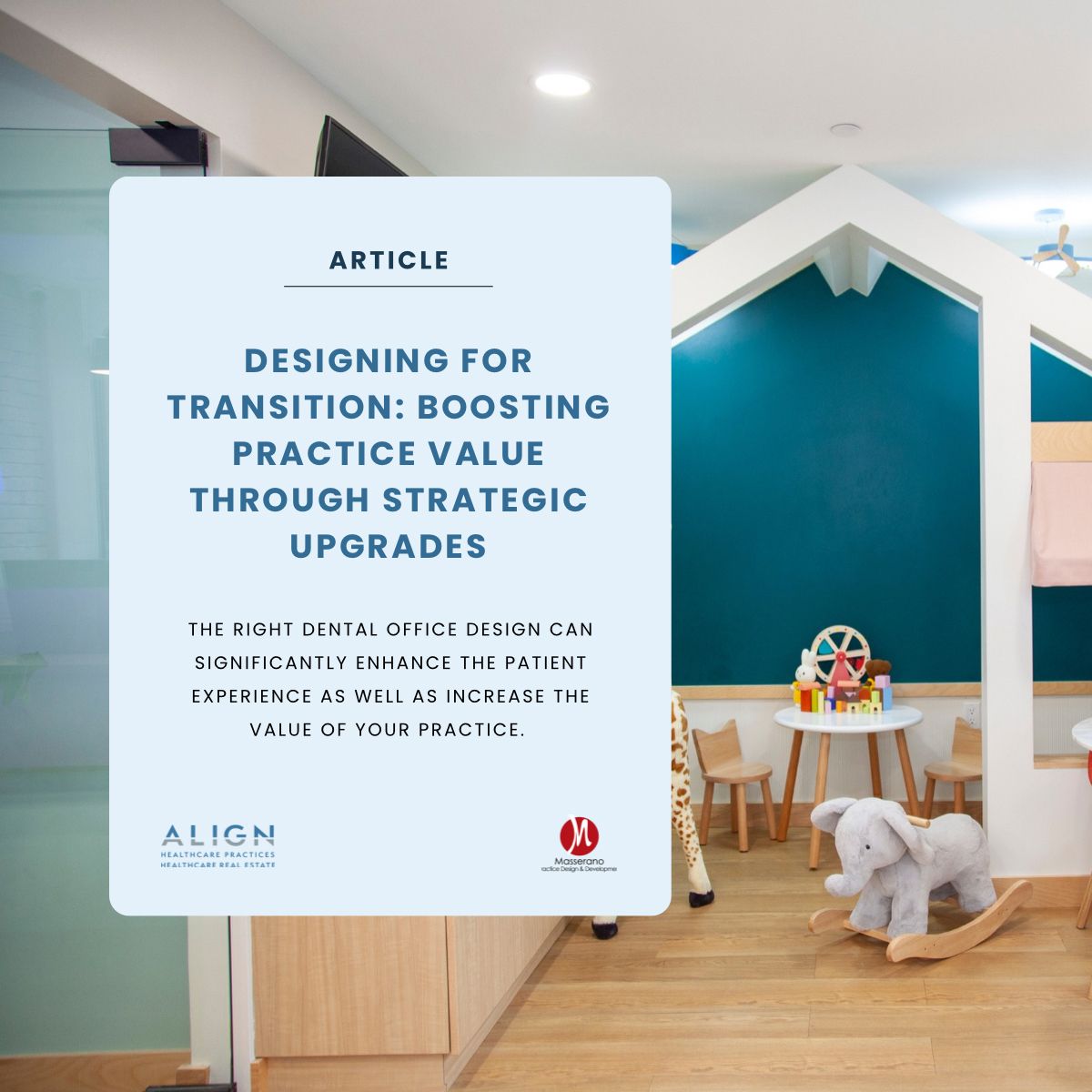
    Designing for Transition: Boosting Practice Value Through Strategic Upgrades

    When planning to sell your dental practice, most dentists think about upgrades solely for patient comfort or aesthetics. But when it comes to preparing for a sale, dental office design becomes a strategic tool that can significantly increase the value of your practice. The right design changes not only enhance patient experience but also make the practice more appealing to prospective buyers.

    Why Design Matters in Practice Transitions

    First impressions matter, especially in a dental practice. The layout and aesthetics of your office create an immediate sense of value to potential buyers. A well-designed space conveys that you’ve invested in your practice and are prepared for a smooth transition.

    From a buyer’s perspective, an updated dental office design makes the practice more attractive and demonstrates that the office is up to modern standards. Buyers are also looking for clinical efficiency, and an intuitive layout can make a practice far more appealing. Investing in design can reduce buyer concerns about future renovation costs, accelerating the sale process.

    Common Buyer Dealbreakers in Outdated Spaces

    Outdated design can quickly become a dealbreaker. Common red flags include:

    • Poor lighting: An office that feels dim or poorly lit can create a negative atmosphere. Modern buyers will be looking for well-lit, inviting spaces.
    • Tight layouts: If your layout feels cramped or difficult to navigate, it may be seen as inefficient. A design that improves flow between operatories is crucial.
    • Old cabinetry and flooring: Worn-out materials or dated finishes can make the practice feel neglected. Dental office upgrades like new cabinetry, flooring, and counters provide immediate improvement with minimal investment.
    • Old operatories: Clinical operatories that lack comfort or modern technology can deter potential buyers. Upgrading equipment and aesthetics is a worthwhile investment.

    High ROI Upgrades Before You Sell

    Not all upgrades need to be expensive to provide a high return on investment. Here are some value-adding dental design strategies:

    • Reception and patient areas: These spaces form the first impression. Consider updating furniture, lighting, and décor for a modern look.
    • Flow improvements: Making minor adjustments to the flow between operatories can increase the efficiency of the space and make it more attractive to buyers.
    • Digital storage and cabinetry: Integrating modern cabinetry and storage solutions is essential for both functionality and aesthetic appeal.
    • Branding: Small changes like updating colors, finishes, and signage can make a big impact on buyer perception.

    How to Plan and Time the Design Process for a Sale

    Timing is everything when it comes to renovations. Ideally, give yourself a 12–24 month runway to plan any upgrades. This gives you enough time to make improvements without causing disruptions to daily operations.

    Focus on cosmetic and functional upgrades rather than major construction projects, which can be disruptive and time-consuming. Partnering with a dental office design firm that specializes in transitions ensures that your upgrades will align with your transition goals.

    The design of your dental practice plays a pivotal role in its sale price and buyer appeal. By focusing on buyer-friendly dental design and making targeted dental office upgrades, you can significantly increase your practice’s value and streamline the sale process.

    Let’s map your practice upgrades around your transition goals—schedule a free consultation with Masserano Practice Design & Development today.


    Originally published May 20, 2025 on masseranopractices.com.

    Planning a startup, relocation or expansion? See how The Masserano Process works, browse our portfolio, or schedule a free consultation.
  • How to Structure the Real Estate Side of a Dental Practice Sale

    How to Structure the Real Estate Side of a Dental Practice Sale

    Selling a dental practice is a complex process, and many sellers focus primarily on the clinical aspects, like patient lists and equipment. However, one critical component that often gets overlooked is the real estate. Whether you own or lease your dental space, how you structure the real estate side of the deal can significantly impact your practice’s valuation and your long-term financial goals.

    Why the Real Estate Matters in a Dental Practice Sale

    When it comes to dental practice sales, the property- whether owned or leased—holds a substantial impact on the final price and ease of transition. If you own the dental practice real estate, selling it alongside the business may simplify the deal, but it also means you have to consider its role in the overall valuation of the practice. If you lease, the terms of your dental office lease can either add value or become a liability.
    For example, a long-term lease with favorable terms can add value to the practice in the eyes of a buyer, while a short-term or unfavorable lease may raise red flags. Structuring the real estate component correctly ensures that you are not leaving money on the table and helps you avoid unnecessary complications during the transaction.

    Options for Dental Practice Owners

    1. Sell with the Practice – This is the most straightforward option. You sell both the dental practice and the real estate to a buyer, typically a private buyer or dental service organization (DSO) affiliate. This approach can simplify the process, but narrows the scope of potential buyers.
    2. Sell to a Third Party and Lease Back- In this scenario, you sell the property to a third-party investor but continue to lease the space. This gives you the opportunity to cash out on the real estate while continuing to operate your dental practice business.
    3. Retain as Income Property- If you want to maintain a source of passive income, consider holding on to the real estate after the practice sale. This strategy allows you to capitalize on real estate appreciation and rent payments, but it also comes with the responsibility of property management.
      1. 1031 Exchange– If you’re selling the property but hesitant due to capital gains taxes, a 1031 exchange may be worth exploring. This tax-deferral strategy allows you to reinvest the sale proceeds into another income-producing property without triggering immediate tax liability. It’s an ideal option for doctors nearing retirement who want to shift from practice ownership to more passive real estate income.

    What to Know if You Lease Your Dental Space

    Leasing adds another layer of complexity to a dental practice sale. If you’re looking to sell, the terms of your dental office lease and how they’re handled during the sale can make or break the deal.
    One critical decision is whether to opt for a lease assignment or a new lease. A lease assignment involves transferring your existing lease to the new buyer, while a new lease would involve renegotiating lease terms with the landlord. Both options come with their pros and cons, and choosing the right path can affect both your sales price and transition timeline.
    Be aware of potential pitfalls such as personal guarantees or unexpected CAM fees (Common Area Maintenance). You’ll also want to conduct thorough real estate due diligence to ensure no hidden liabilities exist before entering into any contract.
    Structuring the Deal for Different Buyer Types
    There are two major types of buyers: Dental Service Organizations (DSOs) and private buyers. Each group prioritizes different aspects of the real estate in the sale.

    • DSOs often prioritize long-term lease stability and the location of the practice in high-traffic areas. Their goal is to minimize risk and ensure that the property aligns with their growth strategy. As such, they may prefer properties with favorable lease terms and an established patient base.
    • Private buyers, on the other hand, may be more concerned with the space’s condition, layout, and long-term potential. They are more likely to have a personal connection to the practice’s location and may want to ensure that the design and flow of the space align with their own vision for the practice.
      Understanding the buyer’s priorities and aligning the real estate terms with their needs can ensure a smoother transition and potentially a higher sale price.

    How to Prepare Your Real Estate for Sale

    Preparation is key when structuring the real estate side of your practice sale. Here are some steps you can take to ensure your space is ready:

    • Review your lease early: Have your lease terms reviewed 12–18 months before the sale to identify any potential issues and to provide ample time for negotiations.
    • Start with real estate due diligence: Pull comparable sales for dental office properties in your area to establish a strong baseline for your dental office valuation. This sets realistic expectations and arms you for smarter negotiations.
    • Consider Potential Rental Income and Expenses: If you’re planning a leaseback or holding the property as an investment, model the financials: estimate rental income, operating expenses, and calculate Proforma Net Operating Income (NOI). Apply a market cap rate to help buyers understand the income potential.
    • Upgrade the space: If your space is outdated, consider light upgrades that can improve its appeal to potential buyers. Cosmetic improvements like fresh paint or updated signage can go a long way.
    • Assemble your transition team: Work with a dental real estate broker, dental attorney, CPA, and real estate consultant to ensure the process runs smoothly.

    The real estate side of a dental practice sale is often the most complex and overlooked aspect of the transaction. Whether you own or lease your space, structuring the real estate component properly can significantly impact your practice’s valuation and your financial future. Partnering with a dental real estate broker or dental real estate experts ensures you’re taking the right steps for a successful transition.

    Book a free real estate transition consultation with Align Healthcare Practices & Real Estate to ensure your sale goes smoothly.

  • Optimizing the Value of Your Dental Practice & Real Estate

    Optimizing the Value of Your Dental Practice & Real Estate

    Optimizing the Value of Your Dental Practice and Real Estate 

    What You Need to Know To Create Maximum Value 

    As a dental practice owner who also owns the real estate where your practice operates, you hold a unique position when it comes time to sell. But selling both the practice and the property isn’t as straightforward as listing them individually. The complexities of both business operations and real estate ownership require an expert understanding of both fields to ensure you’re getting the most value from your sale. That’s where Align can help. We are experts in both dental practice operations and the real estate that houses them, and we are uniquely positioned to help you navigate the process of selling both.

    The Importance of Valuing Both the Practice and Real Estate Together (and Separately) 

    When it comes to selling your dental practice and the real estate that you own, the value of both assets is often tied together, and this combined value can be greater than selling them separately, depending upon the practice buyer. It’s crucial to understand how both factors impact each other to maximize your overall return.
    The real estate valuation process looks different when it’s sold with the practice versus as an independent investment property. Selling real estate that is occupied by a tenant with a long lease, as is typical for a dental office, is largely a function of the rent and mortgage rates. Here price negotiation becomes much more narrow as opposed to selling the property to a private practice owner who views the value of the real estate differently.
    Selling the real estate as part of the practice typically results in a higher combined value for non-DSO buyers, due to factors like tax advantages and business operations tied to the location. We perform real estate valuations without the need for a formal appraisal, saving you costs and providing a more comprehensive analysis. Our valuation considers both the broader market and how the property fits into a dentist buyer’s perception of value.

    How Cap Rates Factor into Real Estate Value

    For investors, the value of your property is largely a math problem: How much income can the property generate, what is my interest rate and how much risk is involved? That’s where the capitalization rate (cap rate) comes in. The formula for cap rate is:
    Cap Rate = Net Operating Income (NOI) / Property Value
    This formula helps determine the expected return on an investment and compare the risk to reward of the investment among other investments. The practice’s rent payments, operating expenses of the property and net income yield are the prime metrics. As an owner-occupant, you have more flexibility with rent and ideally can set the rent to optimize the value of the real estate as well as the practice. 
    For private practice buyers, selling both the practice and the real estate together can result in a higher combined value than if they are sold separately. The property isn’t just a physical asset; it’s an integral part of your business. Private practice buyers can likely benefit from investing in their real estate from tax advantages and price appreciation over time. Each type of buyer and their typical approach to valuation should be taken into consideration when selling your practice.

    Considerations for Selling to a DSO

    If you’re thinking of selling your practice to a Dental Service Organization (DSO), it’s important to understand how they typically handle real estate. DSOs try to be “asset light” when it comes to real estate and usually are not interested in buying real estate.

    Ownership of real estate in itself generally does not increase the value of the DSO and therefore they prefer to lease spaces. So, if you are selling your practice to a DSO, there is more often a need to separate the sale of the practice from the property, making the most viable buyer one looking at the property as an investment and applying the cap rate valuation model. Selling real estate that is occupied by a tenant with a long lease, as is typical for a dental office, is largely a function of the rent and mortgage rates and price negotiation becomes much more narrow as opposed to selling the property to a private practice owner who views the value of the real estate differently. This is a major reason why it is important to utilize a practice broker that is also a commercial real estate broker and expert who can help to create the optimal value for both assets, the practice and the real estate. Align is uniquely positioned to do for its clients.

    Why You Should Talk to Align Before Selling Your Practice and Real Estate

    At Align, we don’t just understand how dental practices run—we also understand the intricacies of real estate ownership. When it’s time to sell both, we bring our expertise in both fields to help you achieve the best possible outcome.

    Here’s how we can make a difference:

    1. We can assess the combined as well as the separated value of both the practice and the property to ensure you understand how they impact each other. Most brokers only focus on one or the other—at Align, we value both assets to determine the strategy and pricing that achieves the best possible outcome for our clients. Valuations of both the practice and real estate is part of our service and there is no need for the cost of an appraiser.
    2. We’ll guide you through a seamless sale process. Whether you are selling the practice and real estate together to the same buyer, or whether we find separate buyers for each, we guide you through the transactions as seamlessly and smoothly as possible.
    3. We’ll help you identify the right buyer for both. We identify the right buyer for both the real estate and the practice, whether it’s an independent buyer, a larger dental group, or a real estate investor. We find the buyer(s) who will give you the best overall return on both assets.

    You don’t have to navigate the complexities of selling both your dental practice and your real estate alone. Contact Align today to discuss your options and how we can help you unlock the full value of both assets. With our deep knowledge of dental practice operations and real estate, we’re here to ensure you get the best return on your investments when it’s time to sell.

  • Dental Practices for sale: What to look for in New Jersey

    Dental Practices for sale: What to look for in New Jersey

    Purchasing a dental practice is a significant investment, and finding the right one can be daunting. This is especially true for dentists looking for practices in New Jersey, where the market is competitive and diverse.
    This blog post will help you make a smart decision when considering dental practices for sale in New Jersey and beyond. We will discuss important factors to keep in mind during your search. By understanding these considerations, you can choose the right practice for you.

    Understanding the Market for Dental Practices for Sale in New Jersey

    New Jersey is home to a thriving dental industry, making it an attractive state for dentists looking to buy a practice. The first step in your search is to understand the local county-based market dynamics. Here are some key points to consider:

    1. Location: The location of the dental practice is crucial. Look for areas with high patient demand, good visibility, and easy access for patients. Consider the competition in the area and the potential for growth.
    2. Demographics: Knowing the age, income, and dental needs of the population can help you see if the practice will succeed.
    3. Local Regulations: Be aware of state and local regulations that may affect your practice. Every county in New Jersey has specific requirements for dental practices, so make sure you comply with all regulations.

    Evaluating Dental Practices for Sale

    When evaluating dental practices for sale, it’s essential to perform thorough due diligence. Here are some critical aspects to consider:

    1. Financial Health: Examine the financial records of the practice, including profit and loss statements, tax returns, and patient records. Understanding the financial health of the practice will help you determine its value and potential return on investment.
    2. Patient Base: Assess the size and loyalty of the patient base. A practice with a large, loyal patient base is more likely to provide steady income and growth opportunities.
    3. Reputation: Research the practice’s reputation in the community. A practice with a good reputation is more likely to attract and retain patients.
    4. Staff: Evaluate the experience and skills of the existing staff. A well-trained and experienced team can be a valuable asset during the transition and beyond.

    Key Considerations for Different Types of Practices

    Different types of dental practices come with unique considerations. Here’s what to look for in some common types:

    Orthodontic Practices for Sale

    Orthodontic practices often have higher profit margins because of specialized services. When evaluating an orthodontic practice, consider

    1. Specialized Equipment: Ensure the practice has up-to-date orthodontic equipment and technology.
    2. Referral Network: A strong referral network with local general dentists can be a significant advantage.
    3. Treatment Plans: Review ongoing treatment plans and the potential for new cases.

    Pediatric Practices for Sale

    Pediatric practices cater to children and often require a child-friendly environment. Key considerations include:

    1. Child-Friendly Environment: Look for a practice with a welcoming and engaging environment for children.
    2. Specialized Training: Ensure the staff has experience and training in pediatric dentistry.
    3. Growth Potential: Assess the potential for growth in the area, especially in neighborhoods with young families.

    Steps to Buying a Dental Practice

    To ensure a smooth acquisition, follow these steps:

    1. Define Your Goals: Determine what you want to achieve with your practice purchase. Consider your career goals, lifestyle, and financial objectives.
    2. Find Listings: Search for dental practice listings through brokers, online platforms, and professional networks. Narrow down your options based on your criteria.
    3. Perform Due Diligence: Conduct a thorough evaluation of the practice, including financials, patient records, and legal considerations.
    4. Secure Financing: Explore financing options and secure the necessary funds to purchase the practice.
    5. Negotiate Terms: Negotiate the terms of the sale, including the purchase price, transition period, and any contingencies
    6. Finalize Sale: Complete the necessary paperwork and finalize the sale with the assistance of a dental practice transition specialist.

    How Align Healthcare Practices Can Help

    At Align Healthcare Practices, we are dental practice brokers who specialize in transitioning dental practices. We have more than 50 years of experience and can help you with every step of the dental practice lifecycle.

    Our services include:

    Quality Listings: We have many dental practice listings in New Jersey and other areas, designed to meet your needs

    Due Diligence Assistance: Our experts help you perform thorough due diligence, ensuring you make an informed decision.

    Financing Support: We connect you with trusted financial partners to secure the necessary funding for your purchase.

    Negotiation Expertise: Our team assists with negotiating favorable terms, protecting your interests throughout the transaction.

    Transition Planning: We provide support during the transition period, ensuring a smooth handover and continued success for doctors who want to be practice owners.

    Conclusion

    Exploring dental practices for sale in New Jersey and beyond requires careful consideration and thorough evaluation. By understanding the market, evaluating practices with due diligence, and working with experienced professionals like Align Healthcare Practices, you can make a successful and rewarding investment.

    Contact Align Healthcare Practices today to learn more about our services. We can help you find the perfect dental practice for sale. Take the next step in your dental career now! Take the next step in your dental career now!

  • To Buy or to Build: Benefits & Disadvantages of Purchasing a Turn-Key Dental Practice

    To Buy or to Build: Benefits & Disadvantages of Purchasing a Turn-Key Dental Practice

    What is a Turn-Key Dental Office?
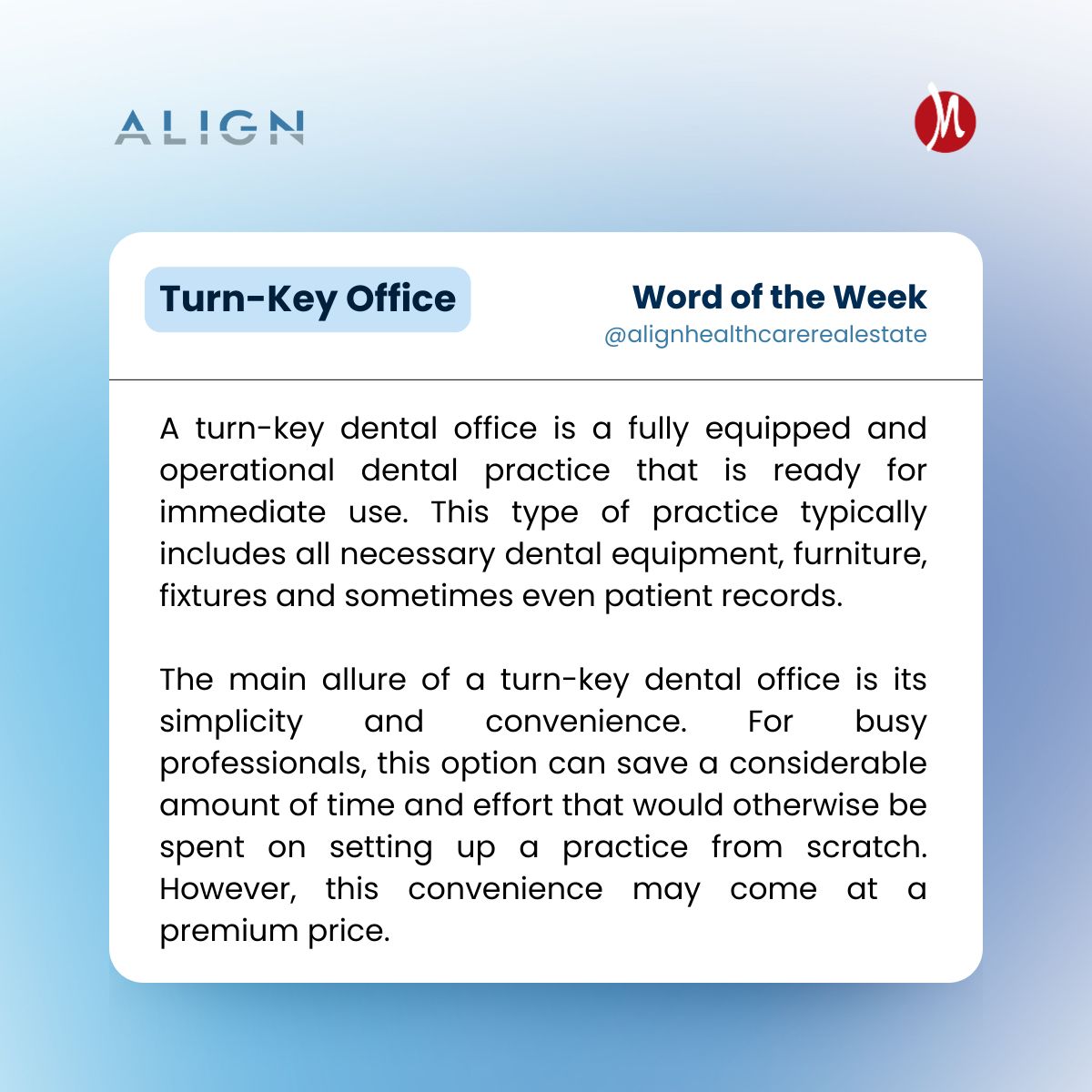
    A turn-key dental office is a fully equipped and operational dental practice that is ready for immediate use. This type of practice typically includes all necessary dental equipment, furniture, fixtures, and sometimes even patient records. Essentially, the new owner can begin seeing patients almost immediately after the acquisition.

    The main allure of a turn-key dental office is its simplicity and convenience. For busy professionals, this option can save a considerable amount of time and effort that would otherwise be spent on setting up a practice from scratch. However, this convenience often comes at a premium price.

    When deciding whether a turn-key dental property makes sense for your business needs, it’s crucial to weigh its costs against what it would take to build out your own dental practice. Building a practice from the ground up involves expenses such as leasing or purchasing a space, designing the office layout, purchasing equipment, and more. These costs can add up quickly but may sometimes be lower than the premium price of a turn-key dental practice. 
    Benefits of Acquiring a Turn-Key Office
    Immediate Operations
    One of the most significant benefits of acquiring a turn-key dental office is the ability to start operations immediately, Since the office is fully equipped and ready to go, you can begin serving patients without the delays associated with setting up a new practice. 
    Established Patient Base 
    In some cases, a turn-key dental practice sale may come with san existing patient bas. This can be a considerable advantage as it eliminates the need for patient acquisition and intake processes, allowing you to generate revenue from day one. 
    Disadvantages of Turn-Key Office Acquisitions 
    Higher Initial Cost 
    One of the main drawbacks of acquiring a turn-key office is the higher the initial cost. The convenience of a ready-to-use practice comes at a premium, and this can be a significant financial commitment. It’s essential to evaluate whether the higher price tag aligns with your long-term business goals. 
    Limited Customization 
    A turn-key office may not offer the same level of customisation as a practice you build from scratch. You may need to make compromises on the office layout, equipment, an design elements, which may not perfectly align with your visions for the practice. 
    Inherited Issues 
    In a turn-key practice acquisition, it is possible to inherit any existing issues, such as staffing problems, operational inefficiencies, or negative patient experiences. It’s crucial to thoroughly evaluate the practice’s history and carry out proper due diligence. 
    Things to keep in Mind
    Location is one of the most important considerations in an dental practice acquisition. A great building or practice in a struggling market area could lead to long-term financial consequences. Conversely, renovating an outdated medical building in a thriving market can deliver an excellent return on investment (ROI). It’s essential to research the local market conditions, including demographics, competition, and economic trends, before making your decision. 
    Conclusion
    Acquiring a turn-key dental office can offer simplicity and convenience, but it’s essential to weigh the costs and benefits carefully. Conducting thorough due diligence is crucial to ensure that the practice meets your needs and expectations. By understanding the various aspects of due diligence and leveraging the expertise of professionals, you can make informed decisions and achieve a successful dental practice transition. 
    How Align & Masserano Can Help
    Align Healthcare Practices, Align Healthcare Real Estate, and Masserano Practice Design & Development are at your service to help guide you through your potential practice acquisition or startup. 
    Whether you are considering acquiring a turn-key dental office or building a practice from scratch, we are your trusted partners in navigating the complexities of dental practice transitions. For more on how buying a practice that is too small can cap future growth, see The Hidden Growth Trap: Why Buying a Small Practice Can Limit Your Future Success. Contact us today for a free consultation so we can help you achieve your practice goals.

  • Guide to Dental Practice Transition Due Diligence

    Guide to Dental Practice Transition Due Diligence

    The Comprehensive Guide to Dental Practice Transition Due Diligence

    Introduction:
    In the realm of dental practice transitions, due diligence plays a pivotal role in ensuring a smooth and successful transition process. It involves a comprehensive investigation undertaken by prospective buyers to confirm specifics and assess risks before finalizing the purchase. In this blog post, we’ll delve into the importance of due diligence, what factors to consider, the types of due diligence involved, how it’s conducted, and how Align Healthcare Practices can assist you throughout this critical phase of your practice transition journey.

    What is Dental Practice Acquisition Due Diligence?
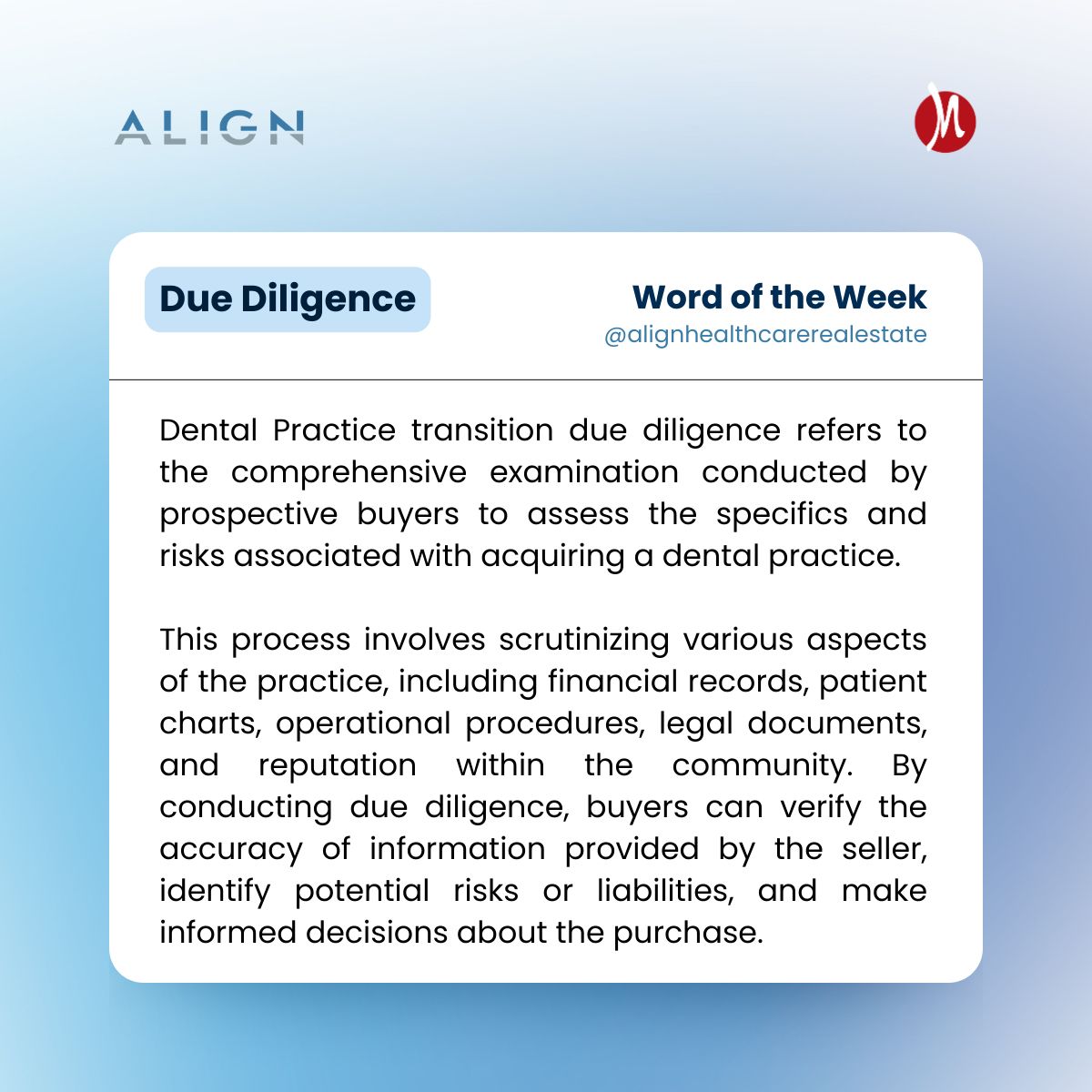
    Due diligence encompasses a thorough examination of all aspects of the dental practice, including financials, charts, reports, bank statements, equipment, supplies, and more. Essentially, it grants the buyer the right to inspect anything practice-related to verify information and identify potential risks or discrepancies.

    Why Does it Matter for Your Dental Practice Transition?
    Due diligence is paramount for safeguarding the interests of both buyers and sellers in a dental practice transition. For buyers, it offers assurance and transparency, allowing them to make informed decisions and mitigate risks. Sellers benefit from a smoother transition process and the establishment of trust and credibility with the buyer.

    What to Consider – Due Diligence Checklist for Practice Transition:
    A comprehensive due diligence checklist is essential for navigating the complexities of a dental practice transition. Key areas to consider include financial, legal, operational, clinical, and reputational aspects. Buyers should meticulously review each item to ensure a thorough assessment of the practice’s overall health and viability.

    Dental Practice Due Diligence Checklist: 
    1. Financial Due Diligence: Involves a detailed analysis of the practice’s financial records, including revenue, expenses, profit margins, and cash flow.
    2. Legal Due Diligence: Focuses on assessing legal documents, contracts, licenses, permits, and compliance with regulatory requirements.
    3. Operational Due Diligence: Examines the practice’s day-to-day operations, workflow efficiency, staffing, management practices, and technology infrastructure.
    4. Clinical Due Diligence: Evaluates the quality of patient care, treatment protocols, patient records, and any potential liabilities related to malpractice claims.
    5. Reputational Due Diligence: Investigates the practice’s reputation within the community, patient satisfaction levels, online reviews, and any past or pending legal disputes.

    How is Due Diligence Conducted and By Whom?
    Due diligence is typically conducted by the buyer or their appointed representatives, such as attorneys, accountants, practice consultants, and dental specialists. These professionals leverage their expertise to conduct thorough investigations and provide valuable insights to the buyer throughout the process.

    How it Varies Based on the Type of Practice Transition:
    The due diligence process may vary depending on the type of practice transition involved. For example, transitioning a specialty dental office may require additional scrutiny of specialized equipment and treatment protocols. If real estate is involved in the transaction, separate real estate due diligence may be necessary to assess property value, lease agreements, zoning regulations, and environmental factors.

    When is Due Diligence Conducted?
    Due diligence typically occurs during the negotiation phase of the practice transition, after the buyer and seller have reached a preliminary agreement but before the finalization of the sale. It is crucial to conduct due diligence in a timely manner to ensure that any issues or concerns are addressed before proceeding with the transaction.

    Typical Practice Transition Timeline/Flow of Events:
    1. Initial Inquiry and Expression of Interest
    2. Preliminary Agreement and Negotiations
    3. Due Diligence Process
    4. Final Agreement and Closing

    How Align Healthcare Practices Can Help:
    Align Healthcare Practices specializes in guiding buyers and sellers through every stage of the dental practice transition process, including due diligence. With Align Healthcare Practices by your side, you can navigate the complexities of due diligence with confidence and peace of mind.

    Conclusion:
    In the realm of dental practice transitions, due diligence serves as a crucial safeguard, allowing buyers to make informed decisions and sellers to facilitate a smooth transition process. By conducting thorough due diligence and leveraging the expertise of professionals, both parties can mitigate risks and ensure a successful transition. At Align Healthcare Practices, we’re committed to empowering our clients with the knowledge and support they need to navigate the complexities of practice transition due diligence and achieve their goals.

  • The Power of Seller’s Discretionary Earnings (SDE) in Doctor-to-Doctor Dental Practice Sales

    The Power of Seller’s Discretionary Earnings (SDE) in Doctor-to-Doctor Dental Practice Sales

    Maximizing Practice Value: The Power of Seller’s Discretionary Earnings (SDE) in Doctor-to-Doctor Dental Practice Sales

    If you are thinking about selling your dental or healthcare practice to another doctor, Seller Discretionary Earnings (SDE) is going to be a valuable metric for communicating the profitability of the practice.

    Whether you’re a buyer or seller, understanding SDE is essential for navigating the complexities of practice transitions with confidence and clarity.
    What are Seller’s Discretionary Earnings (SDE)?
    Seller’s Discretionary Earnings (SDE) is the total financial benefits available to a practice owner, encompassing net income, owner’s salary, non-recurring expenses, and discretionary expenditures. Think of it as the comprehensive snapshot of a practice’s earning potential, providing valuable insights into its financial health and viability.

    Seller Discretionary Earnings give a potential buyer a high level view of the profitability of your practice by showing what undos are left over after expenses. Important to note that SDE would not reflect any long-term expenses financed with debt, such as a mortgage. 
    Significance of Seller’s Discretionary Earnings
    SDE plays a crucial role in evaluating a practice’s profitability and potential for growth. By standardizing various compensation methods, such as distributions and salaries, SDE enables buyers to compare practices on an “apples-to-apples” basis and assess their true earning capacity. It serves as a cornerstone for determining practice value and negotiating favorable terms in practice transitions. In a transition sale, the valuation of the practice can often be based on some multiple of SDE. SDE can also signal if a practice isn’t financially healthy. 
    How do Seller Discretionary Earnings differ from EBITDA? 
    The main difference between these two metrics is the scenario that they would each be utilized in. EBITDA is usually used for private equity or DSO acquisitions and focuses more on operational profitability. SDE is more utilized in doctor-to-doctor transitions or traditional practice transitions. Because the individual doctor would most likely need to secure bank financing for their acquisition, SDE serves as the metric that convinces lenders that the practice is a solid investment and that the buyer can make it profitable. 
    Understanding SDE in Practice Transitions:
    Buyers rely on SDE to determine the fair market value of a practice and make informed investment decisions, while sellers leverage SDE to showcase the earning potential of their practice and attract qualified buyers.

    1. Growth Potential: SDE offers insights into a practice’s growth potential, allowing buyers to assess its scalability and future earnings potential. By understanding SDE, buyers can make informed decisions about practice ownership and pursue opportunities for growth and expansion.
    2. Comparative Analysis: Buyers can compare SDE with their current earnings or market benchmarks to assess the financial attractiveness of practice ownership. SDE provides a benchmark for evaluating the financial viability of practice transitions and identifying opportunities for improvement.
    3. Snapshot of Potential Earnings: SDE provides a clear and concise snapshot of a practice’s potential earnings, giving buyers confidence in their investment and enabling them to plan for future growth and success.
      How Align Healthcare Practices Can Help:
      At Align Healthcare Practices, we specialize in dental practice transitions and valuation strategies. Our experienced team understands the intricacies of SDE and its significance in practice transitions and can help connect sellers with healthcare practice CPAs to advise on correctly calculating their SDEs. Align can assist buyers in comparing practices to each other in order to select the best practice opportunity for their continued growth.

    From conducting thorough financial due diligence to negotiating favorable terms, we provide comprehensive support to ensure successful practice transitions that maximize value for both buyers and sellers.
    Conclusion:
    Seller’s Discretionary Earnings (SDE) serves as a cornerstone in dental practice transitions, offering valuable insights into a practice’s financial performance and growth potential. By leveraging SDE effectively, practitioners can make informed decisions and achieve successful practice transitions. Trust Align Healthcare Practices to navigate the complexities of practice transitions and guide you toward a prosperous future in dentistry.